


Inflammation is often framed as something that begins with injury or stress.
But the more important biological question is not how inflammation starts—it is how it ends.
In a healthy system, inflammation is not a permanent condition. It is a temporary state that follows a full cycle: activation, response, and resolution. The final stage—resolution—is where healing is completed and the body returns to baseline function.
When this stage works properly, inflammation disappears not because it is suppressed, but because it has fulfilled its purpose.
When it fails, inflammation lingers. Not always loudly, but persistently. This is where chronic inflammatory patterns begin to form.
Recovery states are the missing piece in most modern health conversations. They are not passive rest. They are active biological processes responsible for turning off inflammation, repairing tissue, and restoring system balance.
Understanding them changes how we interpret everything from fatigue to skin reactivity to long-term chronic conditions.
Recovery Is Not Rest: It Is a Biological State
One of the most common misconceptions in health is equating recovery with inactivity.
While rest can support recovery, true recovery is not simply “doing nothing.” It is a physiological shift in regulatory systems.
During recovery states, the body:
- downregulates immune activation
- shifts from sympathetic (stress) to parasympathetic (rest) dominance
- repairs cellular and tissue damage
- restores hormonal balance
- clears inflammatory byproducts
These processes require energy, coordination, and timing. Recovery is not absence of activity—it is a different kind of activity entirely.
In scientific terms, this involves the activation of resolution pathways in the immune system, including specialized molecules that actively signal inflammation to stop rather than simply fade out.
The Four Core Conditions for Inflammatory Resolution
For inflammation to fully resolve, several systems must function in coordination.
1. Immune Deactivation Signals
The immune system must receive clear biochemical signals that the threat has been addressed. Without these signals, immune activity can remain partially engaged.
2. Nervous System Downshift
The autonomic nervous system must shift out of sympathetic activation. Chronic stress signaling can inhibit recovery processes by maintaining a state of vigilance.
3. Metabolic Availability
Recovery requires energy. Cellular repair, detoxification, and immune recalibration are metabolically demanding processes.
4. Time Without New Input
Perhaps most overlooked is the need for uninterrupted recovery windows—periods where no new stressors override or interrupt the resolution process.
When these conditions align, inflammation resolves efficiently. When they do not, the system remains partially activated.
The Nervous System’s Role in Recovery
The nervous system is not separate from inflammation—it is deeply integrated into its regulation.
The parasympathetic nervous system, particularly through vagal activity, plays a key role in signaling safety to the body. This “safety signal” is essential for allowing immune systems to transition out of defensive mode.
When the nervous system is chronically activated—through stress, overstimulation, or unresolved emotional load—it can suppress recovery signaling.
This creates a physiological paradox:
- the body continues to perceive threat
- even when no acute threat is present
- preventing full transition into recovery states
Over time, this contributes to a system that is biologically functional, but never fully settled.
Why Modern Life Interrupts Recovery
In ancestral environments, recovery states occurred naturally between periods of stress or activity.
Modern environments, however, often eliminate or compress recovery windows through:
- constant digital stimulation
- irregular sleep patterns
- continuous cognitive engagement
- background sensory input
- emotional or informational overload
Even when the body is physically at rest, the nervous system may still be processing input.
This means many individuals rarely enter true recovery states, even during sleep or downtime.
Instead, they oscillate between mild activation and incomplete rest, never fully completing inflammatory resolution cycles.
Signs the Body Is Struggling to Recover
When recovery systems are not functioning efficiently, the body often communicates this through subtle but persistent signals:
- prolonged fatigue that rest does not fully resolve
- recurring or lingering inflammation
- heightened sensitivity to environmental triggers
- difficulty recovering from illness or stress
- disrupted sleep that feels non-restorative
- emotional reactivity or low resilience
These are not isolated symptoms. They are indicators that resolution processes are not completing efficiently.
Acute Recovery vs. Chronic Recovery Failure
In a healthy system, recovery follows a predictable sequence:
- Stressor or injury occurs
- Immune system activates
- Repair processes begin
- Resolution pathways deactivate inflammation
- System returns to baseline
In chronic inflammation or chronic stress states, this sequence becomes interrupted.
Instead of full resolution, the system may remain in a partially activated state:
- immune signaling continues at low levels
- nervous system remains slightly elevated
- tissues do not fully return to baseline
- energy is diverted toward maintenance rather than restoration
This is not a breakdown of function. It is a stall in completion.
The Role of Sleep as a Recovery Accelerator
Sleep is one of the most important recovery states available to the human body.
During deep sleep phases, several critical processes occur:
- immune recalibration
- glymphatic system activation (brain waste clearance)
- hormonal regulation and reset
- tissue repair and regeneration
Research in neurobiology, including work from institutions such as National Institutes of Health, has demonstrated that sleep disruption is strongly associated with increased inflammatory markers and reduced immune efficiency.
However, sleep alone is not always sufficient if the nervous system remains in a chronically activated state during waking hours.
Recovery is cumulative. Sleep is a major component, but not the only one.
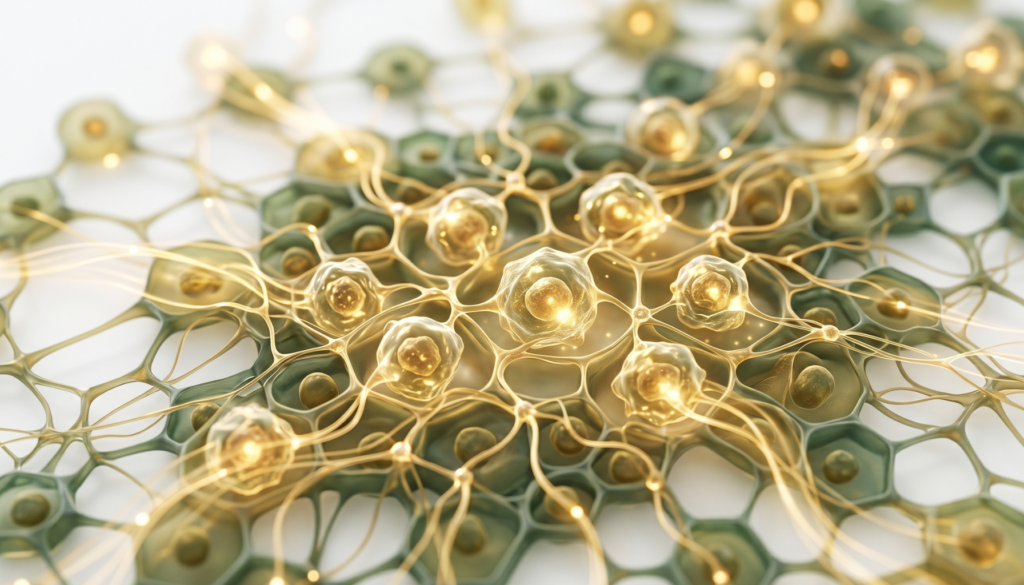
Why Some Systems Fail to Fully Resolve Inflammation
When recovery consistently fails, it is rarely due to a single factor.
More often, it is the result of stacked interference across multiple systems:
Persistent Low-Level Stress
Even mild but continuous stress can prevent full immune resolution.
Lack of Nervous System Regulation
Without downshifting from sympathetic dominance, recovery signaling remains suppressed.
Environmental Overload
Continuous sensory or chemical exposure prevents complete physiological disengagement.
Metabolic Strain
When energy resources are limited, the body prioritizes survival functions over repair processes.
Repeated Activation Without Recovery Windows
If new stressors occur before previous ones resolve, inflammation accumulates over time.
Together, these factors create a system that is always “processing,” but rarely fully resolving.
Recovery Is a Skill, Not Just a State
One of the most important shifts in understanding recovery is recognizing that it is not purely passive.
The body has innate recovery mechanisms, but their efficiency depends on conditions that support them.
Recovery capacity can be influenced by:
- consistency of sleep
- nervous system regulation practices
- environmental design
- nutritional and metabolic stability
- emotional processing and stress resolution
In this sense, recovery is both biological and behavioral.
It is not something that happens automatically in all conditions. It is something that can be supported or disrupted.
The Missing Link in Most Health Models
Many health approaches focus heavily on:
- reducing inflammation triggers
- optimizing diet or supplements
- managing symptoms
- or increasing resilience
While all of these matter, they often overlook the central mechanism:
the body’s ability to complete recovery cycles.
Without completion, even well-managed systems can drift into chronic imbalance.
This is why some individuals improve temporarily but do not fully stabilize long-term—the underlying recovery architecture has not been fully restored.
Reframing Health Through Recovery Capacity
When viewed through the lens of recovery states, health becomes less about avoiding stress and more about maintaining the ability to return to baseline after stress occurs.
This shift is subtle but profound.
It reframes health as:
- flexibility instead of rigidity
- completion instead of suppression
- rhythm instead of constant optimization
- restoration instead of control
In this model, inflammation is not simply a problem to eliminate. It is a process that must be allowed to finish.
Conclusion: Healing as Completion
Inflammation is not inherently harmful. It is a necessary biological response designed to protect and repair the body.
What determines long-term health is not whether inflammation occurs, but whether it is allowed to fully resolve.
Recovery states are where this resolution happens.
When these states are supported, the body completes its healing cycles efficiently. When they are disrupted, inflammation lingers, sensitivity increases, and systems begin to operate under chronic load.
The goal is not to eliminate activation from life.
The goal is to ensure that every activation has a pathway back to resolution.
Because health is not defined by how often the body is challenged.
It is defined by how completely it is allowed to recover.