

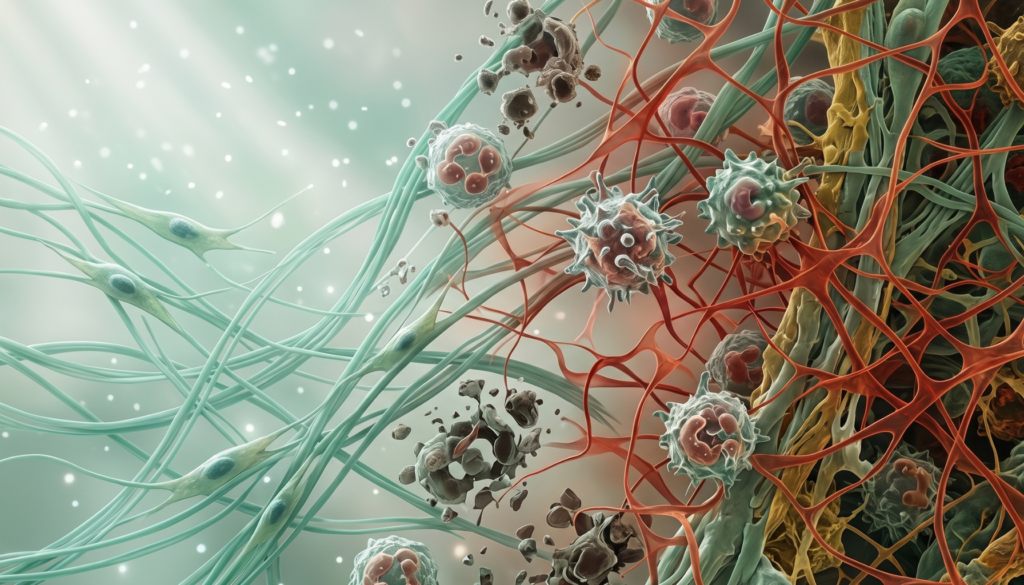
Inflammation is often discussed as something to reduce, calm, or eliminate. But this framing misses a critical biological truth:
inflammation is not the problem. unresolved inflammation is.
In its acute form, inflammation is one of the body’s most sophisticated and necessary survival systems. It is how the body repairs tissue, defends against pathogens, and restores balance after injury or stress.
However, when this system does not properly resolve, it shifts from a targeted healing response into a persistent physiological state that can quietly disrupt nearly every major system in the body.
Understanding the difference between acute and chronic inflammation is essential for interpreting symptoms that otherwise appear disconnected—skin changes, fatigue, digestive issues, mood shifts, or recurring illness patterns.
Acute Inflammation: The Body’s Precision Repair System
Acute inflammation is the body’s immediate response to injury, infection, or cellular damage.
It is not random or chaotic. It is highly organized and time-limited.
When the body detects a threat, it initiates a coordinated cascade of immune activity designed to:
- isolate the affected area
- eliminate harmful agents
- clear damaged tissue
- and begin repair processes
This involves increased blood flow, immune cell activation, and the release of signaling molecules that orchestrate healing.
Common visible signs of acute inflammation include:
- redness
- warmth
- swelling
- tenderness
- and temporary loss of function in the affected area
Although uncomfortable, these signs are evidence that the system is functioning correctly.
As immunologist concepts developed in modern physiology show, acute inflammation is not a malfunction—it is a tightly regulated repair sequence with a defined beginning and end.
Once healing is underway, the immune system activates resolution pathways that gradually return the tissue to baseline.
In a healthy system, this entire process is temporary, localized, and self-limiting.
Chronic Inflammation: When the Resolution Phase Fails
Chronic inflammation begins when the body does not fully exit the inflammatory cycle.
Instead of turning off after the initial trigger is resolved, immune activity remains partially active.
This is not the same intensity as acute inflammation. It is more subtle, more diffuse, and often not immediately perceptible.
Rather than producing obvious swelling or pain, chronic inflammation often manifests as:
- persistent fatigue
- low-level pain or discomfort
- skin sensitivity or reactivity
- digestive irregularities
- brain fog or reduced cognitive clarity
- increased susceptibility to illness
Because these symptoms are non-specific, chronic inflammation can persist for long periods without clear identification.
In essence, the body remains in a state of incomplete resolution.
The Missing Step: Failure of Inflammatory Resolution
A key distinction between acute and chronic inflammation is not the activation phase—it is the resolution phase.
In a healthy inflammatory response, the process follows a complete cycle:
- Trigger occurs (injury, infection, stressor)
- Immune response activates
- Damage is contained and addressed
- Resolution signals deactivate the response
- Tissue returns to baseline
In chronic inflammation, step four is disrupted.
This disruption can occur due to:
- ongoing low-grade triggers that never fully stop
- impaired immune signaling pathways
- metabolic dysfunction affecting cellular repair
- chronic stress influencing hormonal regulation
- or repeated activation before full recovery is achieved
The result is not an acute flare—it is a system that never fully completes its healing cycle.
When Healing Becomes Harm
The phrase “when healing becomes harm” refers to a specific biological paradox:
the same mechanisms that protect the body in short bursts can become damaging when sustained indefinitely.
Inflammatory processes are designed to be temporary. When they persist, they begin to interfere with normal physiological function.
Over time, chronic inflammation can contribute to:
Cellular Stress and Aging
Persistent inflammatory signaling increases oxidative stress, which can damage cellular structures and accelerate biological aging processes.
Tissue Dysfunction
Continuous immune activity can interfere with normal tissue repair and regeneration, leading to functional decline in affected systems.
Metabolic Disruption
Inflammation can alter insulin sensitivity and metabolic signaling, affecting energy regulation and storage.
Neurological Impact
Inflammatory cytokines can influence brain function, contributing to cognitive fog, mood changes, and altered stress response.
This is supported by extensive research in immunology and systems biology, which has identified chronic inflammation as a shared mechanism across many modern chronic conditions.
Why Chronic Inflammation Feels “Invisible”
One of the defining characteristics of chronic inflammation is its subtlety.
Unlike acute inflammation, it does not always produce clear, localized symptoms. Instead, it manifests as a general shift in baseline function.
People often describe this as:
- “not feeling like themselves”
- “always slightly off”
- “never fully recovered”
- or “running at a lower capacity than before”
Because these experiences are diffuse, they are frequently attributed to stress, aging, or unrelated lifestyle factors.
This lack of clear signal is part of what makes chronic inflammation so persistent—it does not always announce itself loudly enough to demand attention.
The Nervous System Connection
The immune system does not operate independently from the nervous system.
These systems are in constant communication through chemical and neural pathways that influence each other’s activity.
Chronic stress activation can contribute to inflammatory signaling through hormonal pathways such as cortisol regulation and sympathetic nervous system dominance.
While acute stress responses can temporarily suppress inflammation, chronic stress can lead to dysregulated immune activity over time.
This creates a feedback loop:
- stress influences inflammation
- inflammation influences stress sensitivity
- both reinforce each other
This is one reason why chronic inflammation is often accompanied by nervous system dysregulation.
The Role of Environment and Lifestyle Load
Chronic inflammation rarely has a single cause.
More often, it emerges from cumulative exposure to multiple low-level stressors over time.
These may include:
- disrupted sleep patterns
- dietary patterns that promote immune activation
- environmental pollutants
- chronic psychological stress
- insufficient recovery time between stressors
- sedentary behavior or metabolic imbalance
Individually, each factor may be manageable. Collectively, they contribute to a sustained inflammatory environment within the body.
This is why chronic inflammation is often described as a load-based condition rather than a single-trigger condition.

Acute vs. Chronic: A Functional Comparison
The key distinction between acute and chronic inflammation can be understood as a difference in timing, purpose, and resolution.
Acute inflammation:
- short-term
- localized
- adaptive
- fully resolves
- supports healing
Chronic inflammation:
- long-term
- systemic or diffuse
- maladaptive when persistent
- fails to fully resolve
- contributes to dysfunction over time
Both originate from the same biological system. The difference lies in whether the system completes its intended cycle.
Why Suppression Alone Is Not the Answer
A common misunderstanding in health is the idea that inflammation should simply be “turned off.”
However, suppression without resolution can create secondary issues.
Inflammation exists for a reason. It is the body’s method of responding to disruption.
The goal is not to eliminate inflammatory capacity, but to restore the ability to:
- activate when needed
- and fully resolve afterward
This distinction is critical.
A system that cannot activate is vulnerable. A system that cannot resolve is chronically burdened.
Recovery as the Defining Mechanism
The difference between health and chronic inflammation is not the presence of stress or activation.
It is the presence of effective recovery cycles.
Recovery is where:
- immune signaling turns off appropriately
- tissue repair completes
- hormonal systems reset
- and the nervous system returns to baseline
Without recovery, even small stressors accumulate.
With recovery, even significant stressors can be processed without long-term dysfunction.
This is why recovery capacity is often more important than the intensity of stress exposure itself.
Conclusion: The Importance of Completion
Acute inflammation is not the enemy. It is a necessary biological response designed to protect and repair the body.
Chronic inflammation, however, represents a breakdown in completion—a system that has initiated healing but has not fully exited the process.
This distinction reframes inflammation entirely.
It is not simply about reducing inflammation, but about restoring the body’s ability to complete what it starts.
When resolution functions properly, inflammation becomes what it was always meant to be:
a temporary, intelligent, and highly adaptive response that serves health rather than undermines it.
The goal is not silence.
The goal is completion.