


Skin is often treated as something cosmetic—an outer layer to be managed, corrected, or perfected.
But biologically, skin is not a decorative surface. It is a living, responsive immune organ. It is constantly communicating with the immune system, the nervous system, and the environment in real time.
When the skin reacts—through redness, breakouts, dryness, flaring, sensitivity, or texture changes—it is rarely an isolated issue. It is often the visible expression of a deeper internal conversation: inflammation seeking a place to show itself.
To understand why skin reacts, we have to move beyond topical thinking and look at how the body prioritizes internal balance over external appearance.
The Skin Is an Immune Organ First
One of the most misunderstood aspects of skin health is its biological role.
The skin is the body’s largest organ, and it functions as a primary immune interface with the environment.
It is not passive. It is actively involved in:
- detecting environmental threats
- regulating microbial balance
- responding to injury and irritation
- and signaling internal immune activity
Cells within the skin, including keratinocytes and immune cells such as Langerhans cells, constantly monitor for disruption.
When something is perceived as a threat—whether external or internal—the skin participates in the inflammatory response.
This is why dermatological symptoms are often not purely “skin problems,” but immune expressions on the surface of the body.
The Skin Reflects Internal Priority Shifts
The body is constantly making decisions about resource allocation.
When internal systems are under stress, the body prioritizes survival functions over surface optimization.
This means that when inflammation, stress, or immune activity increases internally, the skin may become a lower priority in the system’s hierarchy of regulation.
As a result, changes may appear externally:
- barrier weakening
- increased sensitivity
- uneven texture
- inflammatory lesions
- dryness or oil imbalance
These are not random malfunctions. They are signs that internal systems are allocating resources elsewhere.
The Inflammation-Skin Connection
Inflammation is one of the primary drivers of visible skin changes.
When inflammatory signals circulate through the body, they influence the skin through multiple pathways:
- immune cell activation in skin tissue
- increased vascular response (redness, heat)
- changes in sebum production
- disruption of the skin barrier
- altered healing and regeneration cycles
Conditions such as acne, eczema, rosacea, and dermatitis are all associated, in varying degrees, with inflammatory activity.
This does not mean all skin conditions are identical in cause. Rather, it highlights that inflammation is a shared underlying mechanism across many visible skin patterns.
Research in dermatological immunology has increasingly emphasized the role of systemic inflammation in skin conditions, particularly in chronic or recurring presentations.
The Skin Barrier: More Than a Surface Layer
The outermost layer of the skin, known as the stratum corneum, functions as a barrier between the internal body and external environment.
When functioning optimally, this barrier:
- retains moisture
- blocks harmful pathogens
- regulates sensitivity
- and maintains microbial balance
However, when inflammation is present internally or externally, this barrier can become compromised.
A weakened barrier leads to:
- increased transepidermal water loss (dryness)
- heightened sensitivity to products or environment
- increased penetration of irritants
- and a cycle of further inflammation
This creates a feedback loop between internal inflammation and external reactivity.
Why Skin Often Reacts Before Other Systems
In many cases, skin changes appear before more systemic symptoms are recognized.
This is not because the skin is “fragile,” but because it is highly responsive and externally visible.
The skin is constantly exposed to:
- environmental fluctuations
- microbial interactions
- chemical exposures
- physical friction
- and emotional stress responses (via vascular and nervous system pathways)
Because of this, it often serves as an early indicator of internal imbalance.
In other words, the skin is not the origin of dysfunction—it is frequently the first readable output of deeper system stress.
The Nervous System-Skin Axis
The skin is deeply connected to the nervous system through what is known as the neurocutaneous system.
Nerve endings in the skin respond to:
- temperature changes
- touch and pressure
- pain signals
- and emotional stress responses
Stress and emotional activation can directly influence skin physiology through neurochemical pathways.
For example, stress-related release of neuropeptides can increase inflammation and alter immune activity in the skin.
This is one reason why skin conditions often fluctuate with stress levels, sleep disruption, or emotional load.
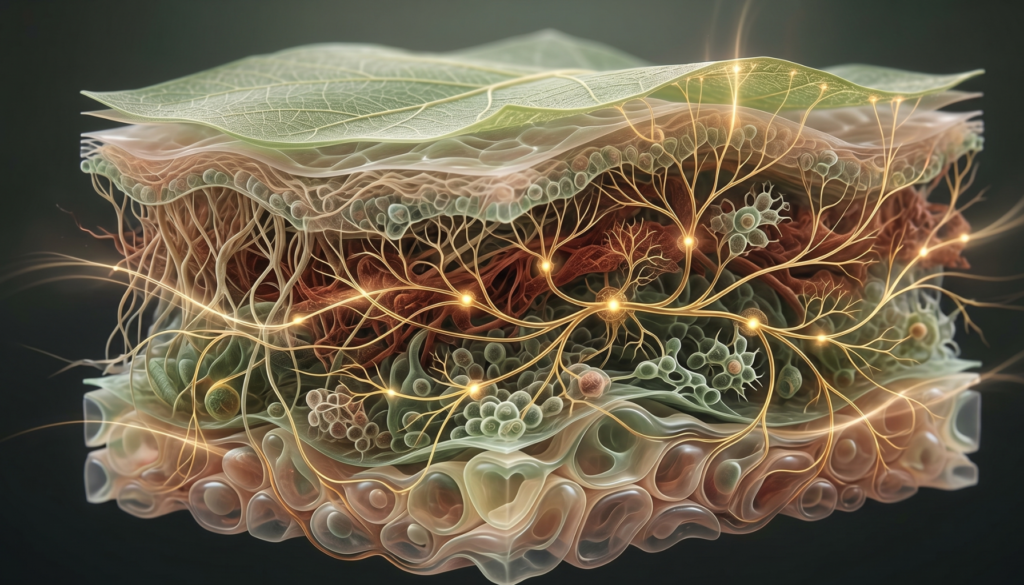
The skin is not separate from the nervous system—it is neurologically embedded in it.
Internal Load and Skin Expression
Skin reactions are often influenced by cumulative internal load rather than a single cause.
This load may include:
- chronic stress activation
- sleep disruption
- digestive imbalance
- hormonal fluctuations
- environmental exposure
- or emotional strain
When total system load increases, the body may express imbalance through the skin as one of its accessible output channels.
This is not symbolic—it is physiological prioritization.
The skin becomes a visible map of internal demand.
Why Topical Solutions Alone Often Fall Short
Topical products can play an important role in supporting the skin barrier, reducing irritation, and providing external reinforcement.
However, they often do not address the underlying drivers of inflammation when those drivers are systemic.
This is why skin issues may persist even with consistent skincare routines.
If the internal inflammatory environment remains active, the skin continues to respond accordingly.
Effective skin support often requires a dual approach:
- external barrier support
- internal system regulation
Neither replaces the other. They operate in different layers of the same system.
The Role of Environment in Skin Reactivity
Environmental exposure plays a significant role in skin inflammation.
Common contributors include:
- air pollution and particulate matter
- UV exposure and oxidative stress
- harsh or synthetic chemical exposure
- climate extremes (heat, cold, humidity shifts)
These factors can directly affect the skin barrier and indirectly influence systemic inflammation.
Importantly, the body’s response to these stressors is shaped by baseline resilience. A well-regulated system may tolerate environmental stress more effectively than a system already under chronic load.
When Skin Becomes Chronically Reactive
Chronic skin reactivity often indicates a system that has entered a state of heightened sensitivity.
In this state, the threshold for inflammatory response is lowered.
This can result in:
- flare-ups from minor triggers
- prolonged healing time
- increased sensitivity to products or environments
- and unpredictable cycles of improvement and irritation
This is not a surface-level issue alone. It reflects a nervous system and immune system that are operating in a more reactive baseline state.
Recovery Capacity and Skin Health
One of the most important but overlooked factors in skin health is recovery capacity.
Recovery capacity refers to the body’s ability to:
- resolve inflammation
- repair barrier damage
- regulate immune activity
- and return to baseline after stress exposure
When recovery capacity is strong, the skin can absorb and adapt to stress without prolonged disruption.
When recovery capacity is diminished, even minor stressors can produce visible skin reactions.
Improving skin health, therefore, often involves strengthening the body’s ability to complete internal recovery cycles—not just reducing exposure.
Conclusion: Skin as a Biological Narrative
Skin is not separate from internal health. It is one of the most visible and responsive expressions of internal biological states.
When the skin reacts, it is not acting independently. It is reflecting a combination of:
- immune activity
- nervous system signaling
- environmental exposure
- and internal load distribution
Understanding this shifts skin from a cosmetic concern to a diagnostic surface of internal communication.
The goal is not to silence the skin. It is to understand what it is communicating and address the systems beneath it.
When internal inflammation resolves and recovery capacity is restored, the skin often reflects that shift naturally.
Not because it is being forced to change—but because the system it belongs to has found equilibrium again.