

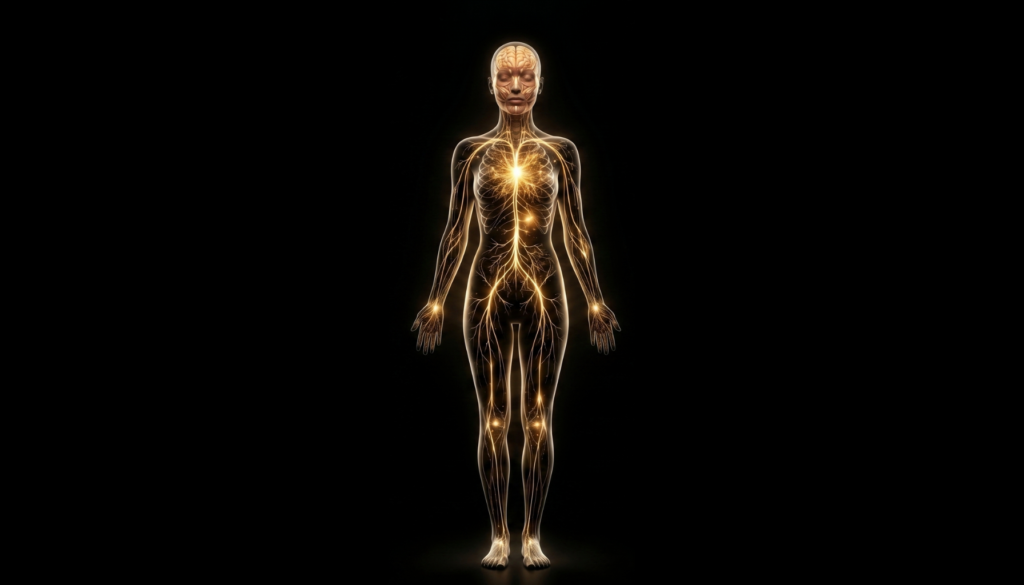
Modern conversations about stress often reduce the experience to a feeling—something subjective, emotional, or situational. Yet what many people are actually experiencing is not simply “stress,” but a persistent shift in nervous system state that shapes how the body functions at every level.
To understand why so many individuals feel chronically overwhelmed, exhausted, anxious, or disconnected, it is necessary to move beyond surface-level explanations and look at the underlying biology. The nervous system is not reacting randomly. It is following patterns that are both predictable and, importantly, reversible when understood.
This article serves as a foundational framework for understanding how the nervous system operates across a spectrum of states—commonly referred to as fight, flight, freeze, and what we will call flow or regulation—and why many people find themselves stuck in one of these states without realizing it.
The Nervous System Is Always Asking One Question
At its core, the nervous system functions as a continuous surveillance system. Through a process known as neuroception, a term introduced by neuroscientist Stephen Porges, the body constantly evaluates internal and external cues to determine whether an environment is safe, dangerous, or life-threatening.
This process happens below conscious awareness. It does not require deliberate thought. Instead, it relies on a combination of sensory input, past experiences, and physiological signals to generate an immediate response.
The outcome of this evaluation determines which branch of the autonomic nervous system becomes dominant:
- The sympathetic nervous system, responsible for mobilization (fight or flight)
- The parasympathetic nervous system, responsible for restoration and conservation (which includes both regulation and, in extreme cases, shutdown)
When functioning optimally, the nervous system moves fluidly between these states in response to changing circumstances. However, under chronic stress or repeated exposure to perceived threats, this flexibility begins to diminish.
Moving Beyond “Stressed” vs. “Calm”: A Functional Spectrum
Rather than viewing the nervous system in binary terms, it is more accurate to understand it as operating along a spectrum of states. Each state has a distinct physiological signature and serves a specific purpose.
1. Fight: Directed Activation
The fight state is characterized by heightened arousal with a sense of direction. It is often associated with anger, frustration, or the urge to confront a perceived threat.
Physiologically, this state involves:
- Increased heart rate and blood pressure
- Muscle tension, particularly in the jaw, shoulders, and hands
- Release of stress hormones such as adrenaline and cortisol
- Narrowed focus on the perceived source of threat
While often framed negatively, the fight response is adaptive when used appropriately. It allows individuals to assert boundaries, respond to challenges, and take decisive action when necessary.
However, when this state becomes chronic, it can manifest as irritability, reactivity, and a persistent sense of tension that affects relationships, sleep, and overall well-being.
2. Flight: Escalating Activation
The flight state represents activation oriented toward escape rather than confrontation. It is often experienced as anxiety, restlessness, or an inability to slow down.
Common features include:
- Rapid, shallow breathing
- Racing thoughts or mental overactivity
- Compulsive productivity or busyness
- Difficulty remaining present or still
In modern environments, where threats are rarely physical but often psychological or social, the flight response is frequently triggered by abstract stressors such as deadlines, financial concerns, or interpersonal dynamics.
Research published in journals such as Psychoneuroendocrinology has demonstrated that chronic activation of the sympathetic nervous system is associated with elevated cortisol levels, which over time can contribute to sleep disruption, metabolic changes, and increased inflammation (McEwen, 2007).
3. Freeze: Protective Shutdown
When the nervous system perceives a threat that cannot be fought or escaped, it may shift into a freeze state. This state is often misunderstood as laziness or lack of motivation, when in reality it represents a protective physiological response.
Characteristics of the freeze state include:
- Reduced energy or chronic fatigue
- Difficulty initiating tasks
- Emotional numbness or detachment
- Brain fog or impaired concentration
From a biological perspective, this state involves increased activation of the dorsal vagal complex, a component of the parasympathetic nervous system associated with immobilization. While this response can be life-saving in extreme situations, prolonged time in this state can lead to feelings of disconnection and depression.
Studies in trauma research, including work summarized by Bessel van der Kolk in The Body Keeps the Score, highlight how unresolved stress and trauma can contribute to persistent freeze responses long after the original threat has passed.
4. Flow (Regulation): Adaptive Stability
The regulated state—sometimes referred to as “flow” or “ventral vagal activation”—is where the nervous system is neither under-activated nor over-activated. Instead, it is responsive, flexible, and capable of engaging with the environment while maintaining internal stability.
In this state, individuals typically experience:
- Steady, rhythmic breathing
- Emotional balance and resilience
- Clear thinking and decision-making
- Capacity for connection and social engagement
This state is supported by the ventral vagal complex, which facilitates communication between the brain, heart, and digestive system. It is also associated with improved immune function, reduced inflammation, and more efficient energy utilization.
Importantly, regulation does not mean the absence of stress. It means the ability to move through stress and return to baseline.

When the System Gets Stuck
Under ideal conditions, the nervous system transitions fluidly between these states. A stressful event triggers activation, followed by resolution and return to regulation.
However, modern life introduces several challenges:
- Chronic exposure to low-grade stressors
- Lack of clear resolution or recovery periods
- High levels of sensory and informational input
- Past experiences that sensitize the nervous system
Over time, these factors can lead to what researchers describe as allostatic load, a term popularized by Bruce McEwen to describe the cumulative wear and tear on the body resulting from chronic stress.
When allostatic load increases, the nervous system may begin to default to a particular state:
- Persistent fight → chronic irritability, tension
- Persistent flight → generalized anxiety, restlessness
- Persistent freeze → fatigue, depression, disengagement
At this point, individuals often interpret these patterns as personality traits rather than physiological states.
The Physiological Ripple Effect
Because the nervous system regulates multiple bodily systems, chronic dysregulation has widespread effects:
Hormonal Function
Prolonged cortisol elevation can disrupt hormonal balance, affecting thyroid function, reproductive hormones, and metabolic processes.
Immune Response
Chronic stress is associated with increased inflammatory markers, including C-reactive protein (CRP) and interleukin-6 (IL-6), contributing to a range of chronic conditions.
Digestive Health
Activation of the sympathetic nervous system inhibits digestion, which can lead to symptoms such as bloating, constipation, or irritable bowel patterns.
Skin Health
The skin, as both a barrier and an immune organ, often reflects internal dysregulation through conditions such as acne, eczema, or sensitivity. Research in Frontiers in Psychology has explored the connection between stress and skin inflammation through the gut-brain-skin axis.
Building Flexibility Rather Than Eliminating Stress
A common misconception is that the goal of nervous system work is to eliminate stress entirely. From a biological perspective, this is neither realistic nor desirable.
Stress responses are essential for survival and adaptation. The objective is not to suppress these responses but to restore flexibility.
Flexibility means:
- The ability to activate when needed
- The ability to return to baseline afterward
- The capacity to tolerate a range of experiences without becoming stuck
This concept aligns with findings in resilience research, which emphasize recovery and adaptability rather than constant calm.
A Practical Framework for Awareness
One of the most effective starting points is simply learning to recognize your current state. This can be approached through observation rather than judgment.
Consider asking:
- What is my energy level right now?
- Is my body tense or relaxed?
- Is my mind racing, foggy, or clear?
- Do I feel connected or withdrawn?
Over time, this awareness creates a map of your nervous system patterns, making it easier to intervene before states become extreme.
Conclusion: From Confusion to Clarity
For many individuals, chronic stress-related symptoms feel unpredictable and disconnected. Yet when viewed through the lens of nervous system states, these experiences begin to form a coherent pattern.
Irritability, anxiety, fatigue, and disconnection are not random failures of willpower. They are physiological responses shaped by environment, experience, and biology.
Understanding the nervous system spectrum provides a framework for interpreting these responses, reducing self-blame, and identifying pathways toward regulation.
It also creates space for a more integrated approach to health—one that recognizes the value of both holistic practices and medical interventions when appropriate.
The goal is not perfection.
It is not constant calm.
The goal is to develop a nervous system that can adapt, recover, and respond to life without becoming trapped in a single state.