


Anxiety is often described as an emotional experience, but what most people actually encounter in the moment is a rapid, full-system physiological event.
It moves through the body faster than language can keep up with it. Heart rate shifts, breath changes, attention narrows, and thought patterns begin to accelerate or fragment. In many cases, the intensity of these sensations creates the impression that something is medically wrong or emotionally unmanageable.
Yet beneath that intensity, anxiety follows a structured biological sequence. It is not random. It is not failure. It is the nervous system doing exactly what it was designed to do under perceived threat.
When we understand that sequence, anxiety becomes less of a mystery and more of a process we can learn to interrupt, soften, and eventually retrain.
Anxiety Begins with Perception, Not Reality
Every anxiety spike begins with a trigger, but that trigger is not always external or obvious.
It may be:
- A physical sensation (heart flutter, dizziness, tight chest)
- A thought or memory
- A shift in environment or sensory input
- A subtle emotional cue that goes unnoticed consciously
The nervous system does not wait for logical analysis. It responds to perceived threat, which is constructed from current input, past experience, and internal sensitivity.
This process is part of neuroception, a term introduced by neuroscientist Stephen Porges to describe how the nervous system evaluates safety without conscious awareness.
In other words, before you “think” anything, your body has already begun responding.
The Brain’s Rapid Threat Interpretation System
Once a potential trigger is detected, the brain rapidly evaluates it through subcortical structures such as the amygdala.
This system is designed for speed, not accuracy.
Its primary function is simple:
detect possible danger and activate protection.
Neuroscientist Joseph LeDoux has shown that this threat detection pathway can bypass higher reasoning centers, meaning the body can initiate a stress response before conscious thought fully forms.
This is why anxiety often feels instantaneous. The physiological shift happens first; interpretation follows.
The Body Enters Activation Mode
Once a threat is perceived, the sympathetic nervous system becomes dominant.
This is often referred to as the “mobilization” branch of the nervous system.
Physiologically, several changes occur:
- Heart rate increases to circulate blood more rapidly
- Breathing becomes faster and more shallow
- Muscles tense in preparation for action
- Digestion slows to conserve energy
- Stress hormones such as adrenaline are released
These changes are not malfunctioning. They are adaptive responses designed for survival situations.
The issue in modern life is that these systems are often activated by non-life-threatening stimuli, such as thoughts, digital overload, emotional stress, or internal sensations.
Interoception: When the Body Becomes the Trigger
As these physiological changes unfold, the brain continuously monitors internal signals through a process called interoception.
This includes awareness of:
- Heartbeat intensity
- Breath rhythm
- Muscle tension
- Gastrointestinal sensations
For individuals with heightened interoceptive sensitivity, these signals are detected quickly and sometimes interpreted as alarming.
A normal increase in heart rate, for example, may be perceived not as “activation,” but as “something is wrong.”
This is where anxiety often intensifies—not from the original trigger, but from the interpretation of bodily sensation itself.
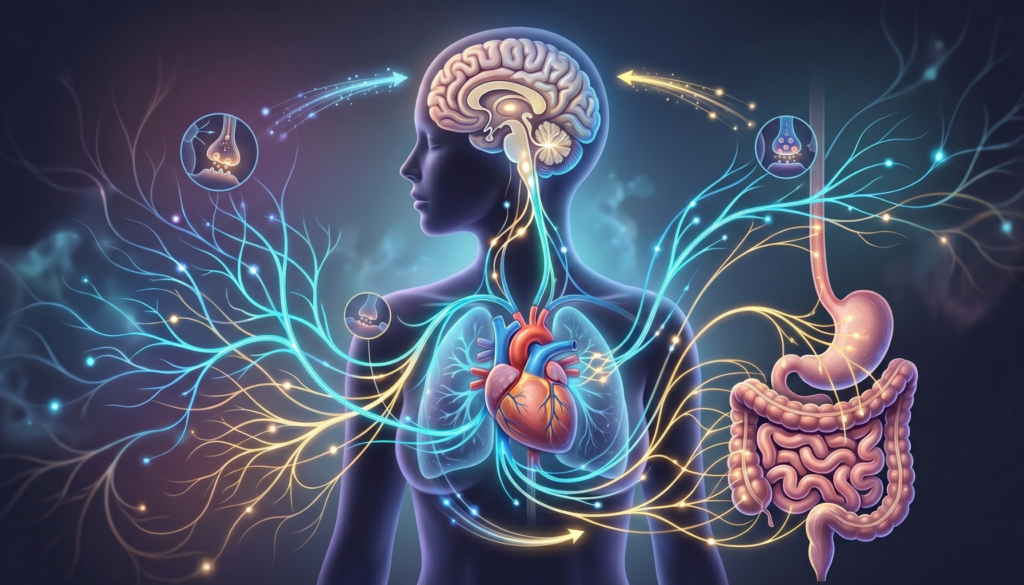
The Feedback Loop That Escalates Anxiety
Once interpretation enters the system, anxiety becomes self-reinforcing.
The loop typically looks like this:
- A sensation arises (e.g., fast heartbeat)
- The sensation is interpreted as threatening
- Emotional response (fear) increases
- The nervous system escalates activation
- Sensations become stronger or more noticeable
Each cycle reinforces the next.
This is why anxiety can escalate so quickly. It is not a linear progression—it is a feedback loop between body and perception.
Peak Activation: When the System Fully Engages
At the height of an anxiety spike, the body may feel overwhelming or unstable.
Common experiences include:
- Rapid heartbeat or palpitations
- Shortness of breath or air hunger
- Dizziness or lightheadedness
- Chest tightness
- Trembling or internal shaking
- A sense of unreality or detachment
- Cognitive narrowing or racing thoughts
Although these sensations are distressing, they are not inherently dangerous. They reflect a system operating in full protective mode.
The perception of danger, however, is what makes the experience feel so convincing.
Why Anxiety Feels So Real
One of the most important aspects of anxiety is that it is not imagined.
The body is genuinely responding.
Muscles are engaged. Hormones are active. Breathing is altered. Attention is narrowed.
The challenge is not that the response is fake—it is that it is misaligned with the actual level of external threat.
This mismatch between internal state and external reality is what creates distress.
Natural Points of Intervention in the Cycle
The most effective way to work with anxiety is not to suppress it, but to interact with the cycle at different stages.
This creates multiple opportunities for regulation.
1. Interrupting Sensory Escalation
The nervous system is highly responsive to sensory input. Shifting sensory conditions can begin to down-regulate activation.
Examples include:
- Moving to a quieter space
- Softening lighting
- Reducing visual or auditory stimulation
- Grounding attention in physical contact (feet on floor, hands on surface)
These inputs signal safety through the sensory system before cognition fully catches up.
2. Shifting Breath Patterns
Breath is one of the most direct interfaces with the autonomic nervous system.
During anxiety, breath tends to become shallow and rapid, reinforcing activation.
Slowing the breath, especially extending the exhale, can begin to shift the system toward regulation.
Even simple patterns such as:
- Inhale gently through the nose
- Exhale slowly and fully
can signal to the body that urgency is not required.
3. Reorienting Attention
Anxiety intensifies when attention turns inward exclusively—especially toward bodily sensations.
Gently redirecting attention outward can reduce internal amplification.
This might include:
- Noticing objects in the room
- Engaging in conversation
- Describing the environment in detail
- Using grounding techniques that involve sight, sound, and touch
This is not avoidance. It is expanding the attentional field so the nervous system is not locked into internal feedback loops.
4. Somatic Discharge and Movement
The nervous system is designed for activation followed by completion of response.
When activation has nowhere to go, it can become stuck.
Gentle movement can help complete this cycle:
- Walking
- Stretching
- Shaking out limbs
- Slow, rhythmic motion
These actions communicate to the body that the activation phase is resolving.
Why the Nervous System Becomes Sensitive Over Time
Repeated anxiety spikes can increase baseline sensitivity.
This is often due to:
- Chronic stress exposure
- Lack of recovery periods
- Past experiences that shaped threat perception
- High sensory or emotional load
- Limited nervous system regulation skills
Over time, the system becomes more reactive—not because it is broken, but because it is adapted to anticipate activation.
Where Clinical Support Fits (Without Dominating the Model)
For some individuals, anxiety becomes frequent, intense, or disruptive enough that additional support is necessary.
In these cases, clinical care may include therapeutic support and, when appropriate, medication as part of a broader stabilization strategy.
However, this is not the foundation of nervous system work—it is a supportive layer when needed.
The core work remains centered on:
- awareness
- regulation skills
- environmental shaping
- and restoring nervous system flexibility
Conclusion: From Reaction to Recognition
Anxiety spikes feel chaotic because they move faster than conscious thought. But beneath that speed is a structured physiological process that can be understood and influenced.
When the sequence becomes familiar, the experience changes:
- sensations become signals instead of threats
- activation becomes recognizable instead of overwhelming
- and recovery becomes something that can be supported rather than waited for
The goal is not to eliminate anxiety entirely. The nervous system is not designed for constant stillness.
The goal is flexibility—the ability to activate, respond, and return to baseline without becoming trapped in escalation.
With awareness and consistent practice, the nervous system begins to learn a new pattern:
not avoidance of activation, but confidence in recovery.